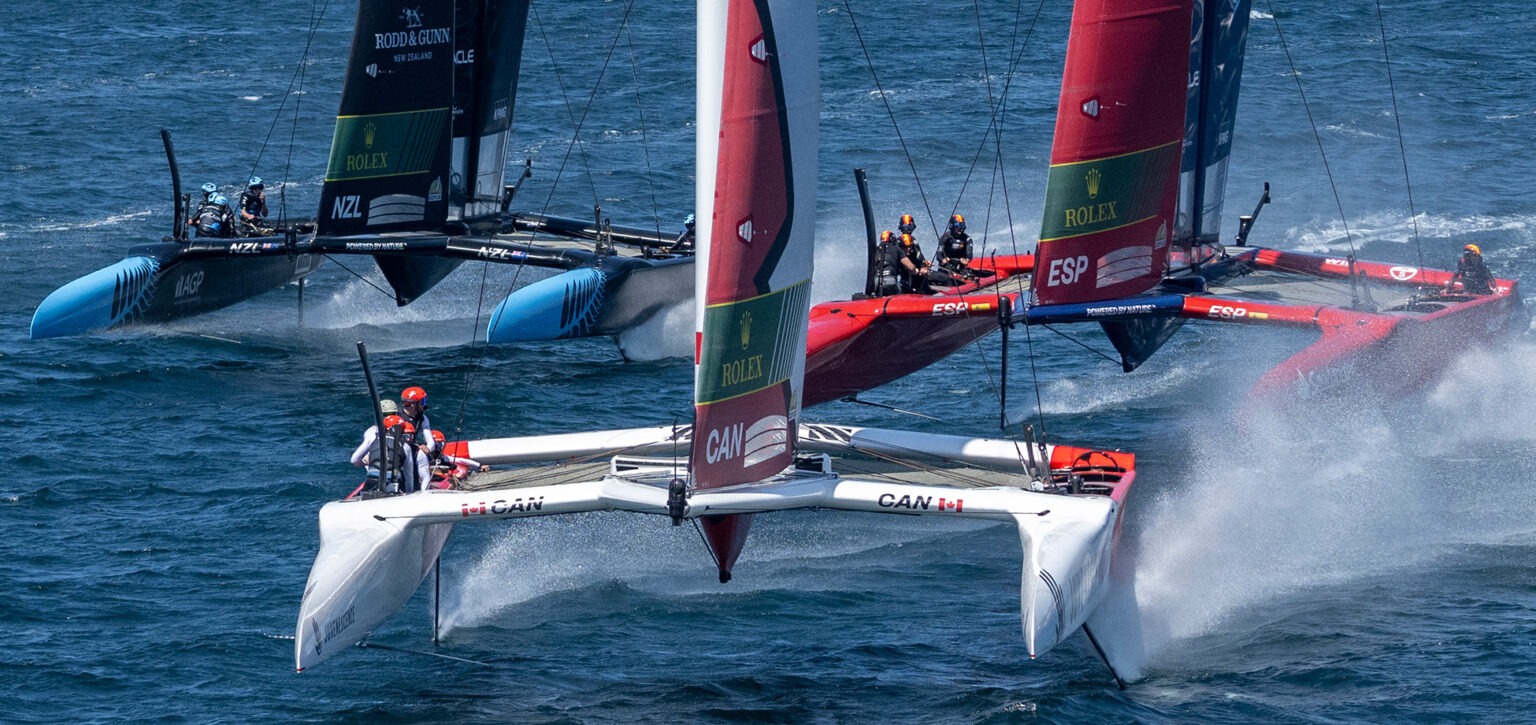
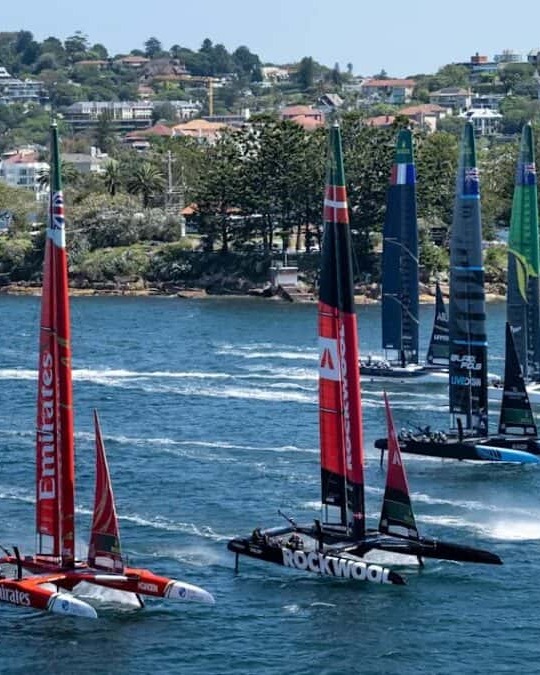
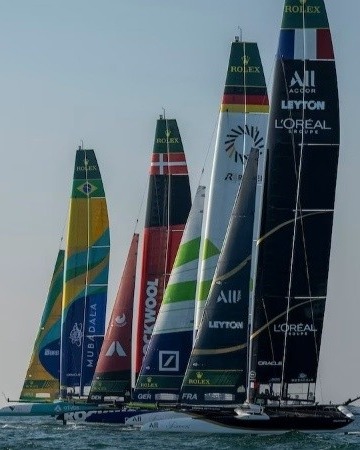
For most of its history, competitive sailing happened far from anyone who might watch it. Races ran for hours over courses miles offshore, and the result reached the public long after it was decided. SailGP set out to change that. Since 2019, national teams have raced identical catamarans that lift clear of the water, on short courses laid a few meters from the shore, in front of grandstands and live cameras, with every boat’s speed and position on screen as it happens.
The comparison with Formula 1 is more than a slogan. Every team races the same machine, so the difference comes down to the crew, and the league tours major cities over the course of a season. It is sailing rebuilt as a spectator sport: short, close and easy to follow.
Born from a Defeat
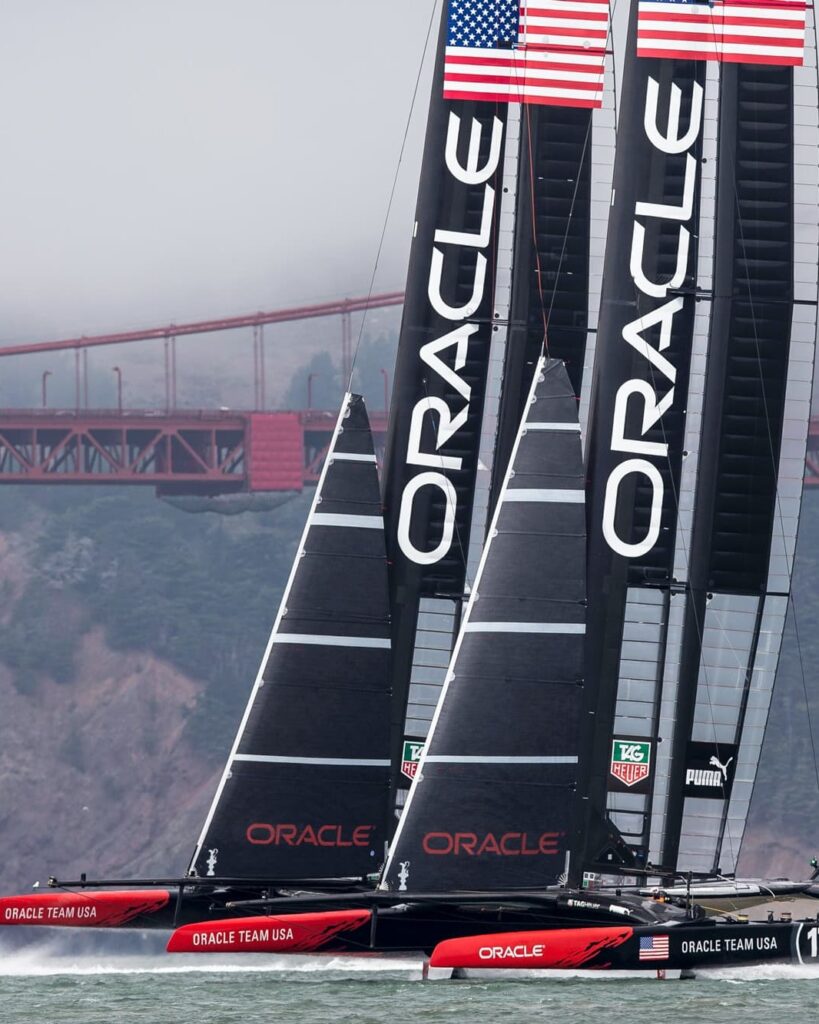
The league was founded in 2018 by Larry Ellison, the co-founder of Oracle, and the New Zealand sailor Sir Russell Coutts, who still runs it as chief executive. Together they had already won the America’s Cup twice, in 2010 and 2013.
The idea took shape after the American team lost the Cup to Emirates Team New Zealand in Bermuda in 2017. Coutts has said that Ellison called to ask whether he wanted to contest the Cup again. When Coutts said no, Ellison said he did not want to either, and suggested they build something new.
The first season, in 2019, had six teams, all of them owned by the league. Over time the teams passed to private investors, and the buyers increasingly come from the business of sport. In February 2026, Doug DeVos, whose family is part of the Orlando Magic’s ownership group, bought the Danish team in a record US$60 million deal. In June, the sale of the New Zealand team to the private equity firm MSP Sports Capital left all 13 teams privately owned.
The Boat
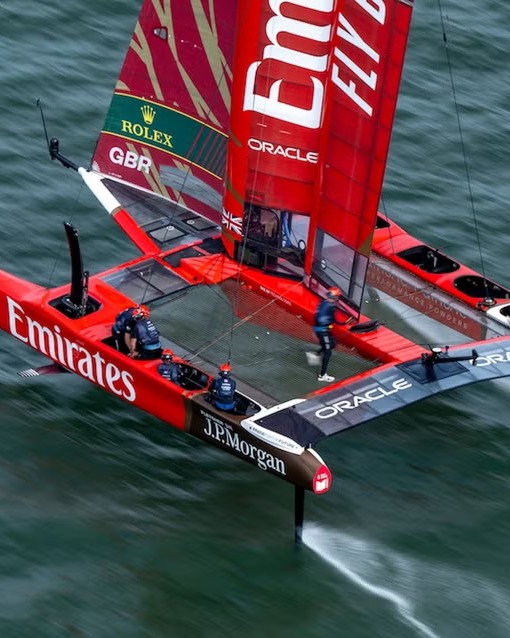
The boat is the F50, a foiling catamaran derived from the AC50s of the 2017 America’s Cup and rebuilt under strict one-design rules. Every team sails an identical boat, built by Core Builders Composites in New Zealand, which rules out a technology arms race and puts the focus on the sailors. It is 15 meters long and 8.8 meters wide, and in place of a soft sail it carries a rigid wing, 24 meters tall in its standard form and swapped for taller or shorter versions as the wind changes.
The speed comes from hydrofoils, blades beneath the hulls that lift the boat out of the water and strip away drag. Since 2025, the fleet has raced on titanium T-foils, which replaced the earlier L-shaped boards. On August 22, 2026, in Sassnitz, Germany, the French team set the league’s speed record at 107.63 km/h, or 58.11 knots. It was a fast day all round. Denmark hit 106.79 km/h before nosediving, and Spain 106.55, both well past the previous record of 103.93 km/h, which Denmark had set at the same venue a year earlier.
Six sailors share the work, each with a precise job. The driver steers. The strategist reads the wind and the opposition. The wing trimmer shapes the wing, the flight controller decides how high the boat flies above the water, and two grinders turn the handles that generate the hydraulic power that moves the wing.
The Weekend
Each Sail Grand Prix runs over two days of fleet racing on short courses with virtual boundaries, laid close to shore. Everything is tracked electronically, so spectators follow speeds, positions and penalties in real time. The weekend ends in a final where only first place counts. With 13 boats now on the water, the league has also been experimenting with splitting the fleet in two, sending the top two from each group into a four-boat final.
Results feed the championship table. An event winner takes 10 points, and only the top ten score. At the end of the season, the three highest-placed teams meet in the Grand Final, a single winner-takes-all race in which nothing earned before it counts.
The Title Fight
The 2026 season is the largest in the league’s history, with 13 teams and 13 events, and two remain. Tom Slingsby’s Australia, the Bonds Flying Roos, leads on 94 points, ahead of Diego Botín’s Spain, Los Gallos, on 78. Both have already secured their places in the Grand Final.
The third place is still open. Sweden’s Artemis, the newest team in the league, sits third on 59, ahead of the United States on 56 and the defending champion, Great Britain, on 53. France, Canada’s NorthStar, Denmark and Switzerland can still mathematically reach it. It will be settled over the last two weekends of November: Dubai on the 21st and 22nd, then the Grand Final at Emirates Palace in Abu Dhabi on the 28th and 29th, where the winning team takes a US$2 million prize.
The trophy has changed hands more than once. Australia won each of the first three seasons, in 2019, 2021–22 and 2022–23. Spain took 2023–24, and Great Britain won last season’s title, decided in Abu Dhabi in November 2025.
Beyond Speed
SailGP runs a second championship alongside the first. The Impact League scores teams on their environmental and social record against ten criteria, from travel and accommodation to food and diversity. Last season, Great Britain won both championships.
Women came aboard in 2021. From Cádiz that October, the Women’s Pathway Program added a sixth seat to every crew, which until then had been five. Australia’s Nina Curtis became the first woman to win a SailGP event, and the seat has most often been the strategist’s.
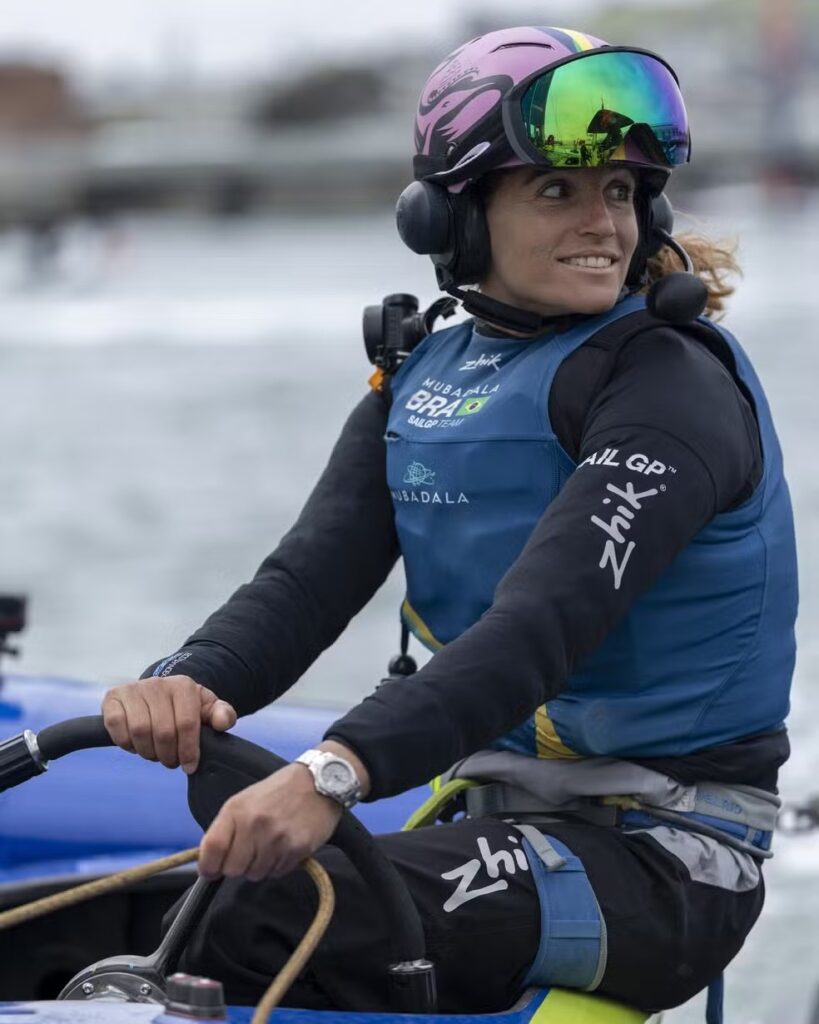
Martine Grael changed that picture. The Brazilian, a two-time Olympic champion, became the first woman to drive an F50 in the league, at the helm of Brazil’s team, and in 2025 she steered it to its first fleet-race win, in New York.
South America
In April 2026, Rio de Janeiro hosted SailGP’s first event in South America, on Guanabara Bay, with Sugarloaf Mountain behind the course. Australia won it. The league has already confirmed the city’s return on October 9 and 10, 2027, again as the only South American stop.
With an Olympic champion at the helm, a fixed date on the calendar and the season broadcast through Globo and BandSports, Brazil has become the sport’s way into the continent.
SailGP set out to show that sailing could be fast, close to the crowd and easy to follow. With the speed record broken two years running, every team in private hands and a place in the Grand Final still open, the case is largely made. The rest will be decided in Abu Dhabi at the end of November.
Business & Lifestyle files are reported by the desk and carry no byline.