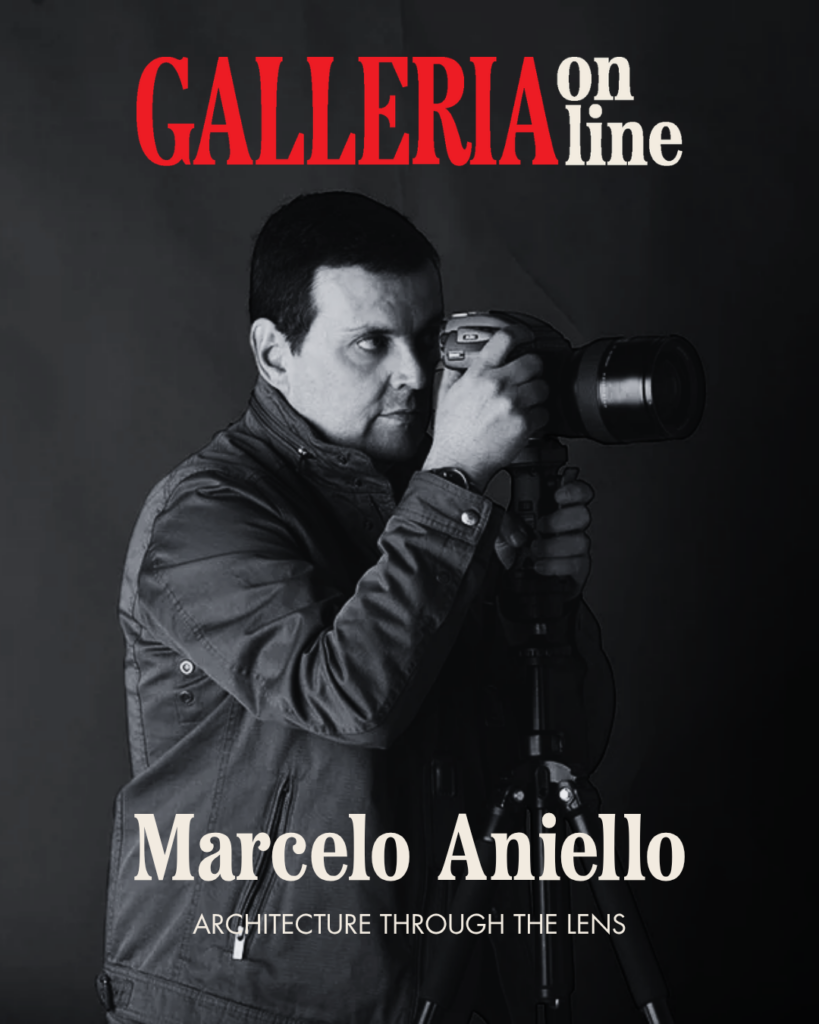
Marcelo Aniello’s work looks at architecture not only as space, but as memory, atmosphere, and visual permanence.
Architecture is not finished when construction ends. A project may be completed in concrete, wood, glass, stone, and light, but its public life often begins through images. Most people will never physically enter the homes, hotels, private villas, or interiors that shape the visual language of contemporary design. They will encounter them through photography, books, magazines, exhibitions, and archives.
That is where Marcelo Aniello’s work finds its place.
As a photographer connected to architecture, interiors, design, travel, and lifestyle, Aniello understands that an image is not merely a record. It is a form of translation. A strong architectural photograph does not only show what a space looks like. It communicates proportion, atmosphere, intention, and silence. It helps the viewer understand the feeling of a room before stepping inside it.
His work has appeared in architectural and design contexts, including ArchDaily, where his photographs of Casa DP, a project by GN Architecture with interiors by Maresca Interiors in Trancoso, Brazil, are part of the platform’s architectural record. This kind of visibility matters because it places photography inside a larger system of memory. A project becomes searchable, referential, and influential beyond the people who commissioned or designed it.
Aniello’s recent editorial project, Modern Escapes: Miami, expands that language further. Edited by Marcelo Aniello and Thomas Martire and published by LARTIGIANO LLC, the 424-page book positions Miami through architecture, lifestyle, travel, and culture. It does not treat the city only as a destination, but as a layered environment shaped by neighborhoods, private spaces, tropical modernity, design, landscape, and the art of living.
This approach feels particularly relevant in Miami, a city often reduced to spectacle. The surface is familiar: beaches, nightlife, luxury towers, celebrity culture, and visual excess. But Miami’s more interesting identity often exists slightly away from the obvious frame. It is found in the tension between tropical nature and urban ambition, in the relationship between privacy and display, in the way architecture responds to heat, light, water, and cultural movement.
Through this lens, Aniello’s work does not simply document buildings. It participates in the construction of place. Photography becomes a way of deciding what deserves attention, what should be preserved, and what kind of story a city tells about itself.
That is the central reason his work belongs in Galleria’s editorial world. Galleria is interested in the visual culture of success, and architecture is one of its most powerful languages. A home can communicate achievement, taste, privacy, family structure, investment, and identity. A hotel can communicate aspiration. A city can communicate possibility. But without image, much of that language remains local, private, or temporary.
Aniello’s photography helps extend the life of those spaces. It turns interiors into references, houses into narratives, and cities into visual archives. In an industry where design often depends on perception, the photographer becomes more than someone who arrives after the project is done. He becomes part of how the project will be remembered.
There is also a quiet discipline in this kind of work. Architectural photography demands patience. It requires understanding light, waiting for the right condition, reading volumes, respecting the architect’s intention, and knowing when to remove distraction from the frame. The best image is not always the most dramatic one. Often, it is the one that allows the space to speak without being forced.
That restraint is increasingly rare in a visual culture driven by speed. Images are produced, posted, consumed, and forgotten quickly. Aniello’s work, especially through the book format, resists that rhythm. A book slows the image down. It asks the viewer to move through spaces with attention. It gives architecture a longer life than a feed can offer.
Modern Escapes: Miami also places Aniello in a broader editorial role. He is not only behind the lens; he is part of the way the narrative is framed. That distinction matters. The photographer becomes an editor of atmosphere, a curator of visual meaning, a translator between private spaces and public imagination.
For Galleria, Marcelo Aniello represents the power of image as legacy. His work reminds us that architecture can be lived in, sold, visited, admired, and remembered, but the image is often what allows it to travel.
A project may be completed in space. Through photography, it continues.