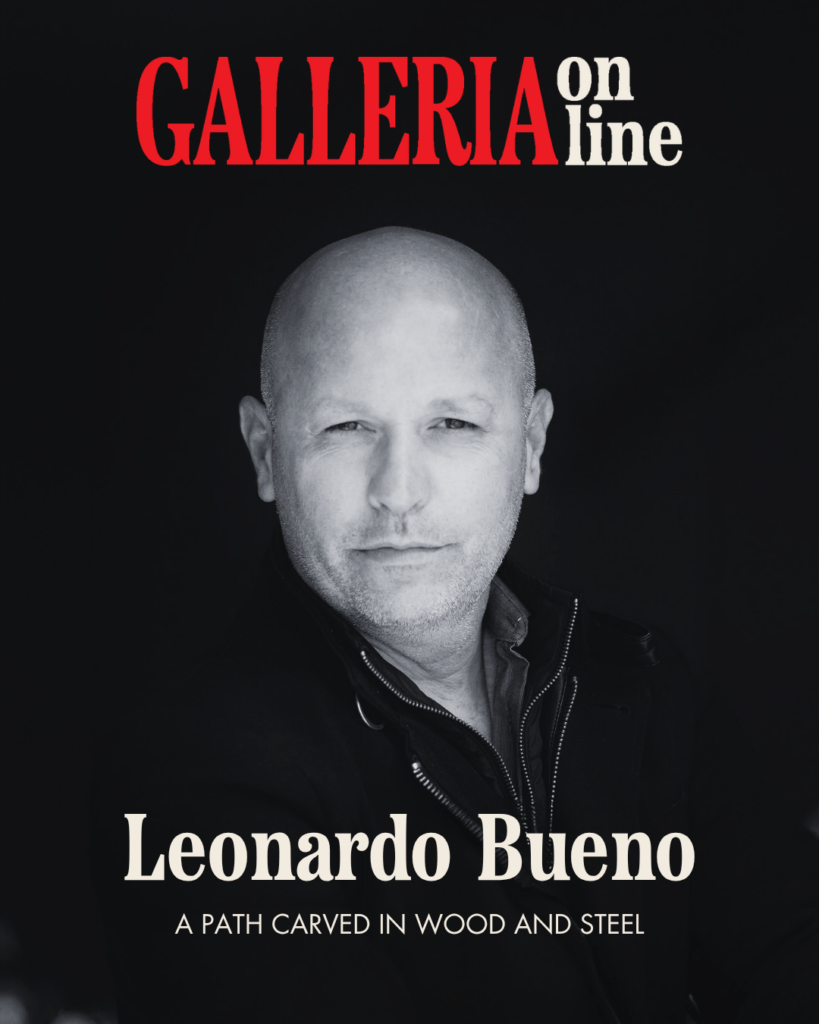
Leonardo Bueno’s work begins with matter: wood, steel, surface, weight, texture, and time. But what defines his production is not only the material he chooses. It is the way he transforms those materials into presence. His pieces do not behave like background objects. They hold the room.
Born in Maria da Fé, in the south of Minas Gerais, Bueno began his career in 2002, when his first creations started to take shape. His official biography describes a practice built around wood and steel, transformed into furniture, sculptures, and objects through a concept he calls “A Leveza do Bruto,” or the lightness of the raw. It is a phrase that captures the tension at the center of his work: the attempt to turn heavy, cold, resistant matter into something expressive, warm, and alive.
That tension is what gives his pieces their identity. Wood can be dense, irregular, marked by time. Steel can be hard, industrial, and unforgiving. In Bueno’s hands, those materials do not lose their strength. They are not disguised. Instead, they are reorganized into objects that carry both force and sensitivity.
His work sits between art and design, between the functional and the sculptural. A chair, table, wall sculpture, or object may have a place inside a home, gallery, or architectural environment, but it does not disappear into function. It asks to be seen. It changes the atmosphere around it.
This matters because contemporary luxury is moving away from simple polish. The most interesting spaces today are not defined only by expensive finishes or recognizable brands. They are defined by pieces that bring authorship, material presence, and a sense of origin. In that context, Bueno’s work feels aligned with a more mature idea of luxury: not the luxury of excess, but the luxury of the singular.
His trajectory also carries the strength of place. Maria da Fé is not incidental to the story. The city, located in the mountains of Minas Gerais, gives his work a sense of distance from the obvious centers of design production. In a market often organized around major capitals, fairs, and fast visual circulation, Bueno’s practice suggests another rhythm. It is rooted in making, in material intimacy, and in the idea that a strong visual language can come from a place of quiet persistence.
The city’s own tourism platform presents Leonardo Bueno Arte e Design as part of Maria da Fé’s creative identity, describing him as a multifaceted creator whose pieces in wood and steel carry meaning, story, and a personal vision of the world. That description matters because it places his work not only within design commerce, but within the cultural landscape of the region.
Bueno’s presence on platforms such as 1stDibs also expands that conversation. His work circulates in a global design marketplace, while still carrying a very specific Brazilian origin. This combination is valuable: local authorship with international visibility. It allows his pieces to move across homes, collections, galleries, and curated interiors without losing their source.
For Galleria, Leonardo Bueno represents a kind of success that is built through authorship rather than scale. His work is not designed to look anonymous. It does not follow the logic of mass production, where repetition creates efficiency and identity is diluted. Instead, each piece seems to insist on the presence of the maker. The object has a body, but it also has a biography.
This is especially relevant in interiors. Many spaces can look expensive. Fewer spaces feel personal. A piece by an artist-designer like Bueno can shift that perception because it introduces tension, texture, and memory. It tells the viewer that someone made a choice beyond the expected. It gives the space a point of view.
There is also a business lesson inside his trajectory. In a world where brands often chase rapid growth, Bueno’s career suggests the value of building a recognizable language over time. Since 2002, the core of his work has remained tied to matter, process, and identity. That consistency creates recognition. Recognition becomes value. Value becomes reputation.
His participation in design events and exhibitions, including programming connected to DW! São Paulo Design Week, reinforces the position of his work within a broader Brazilian design conversation. He is not only producing objects. He is contributing to a discussion about material, authorship, territory, and the emotional role of art inside contemporary living.
The phrase “A Leveza do Bruto” remains central because it is not only aesthetic. It is also philosophical. It suggests that strength does not need to be rigid, that rawness can become elegance, and that material can carry emotion when handled with intention.
Leonardo Bueno’s work reminds us that design can still carry the force of the hand. It can be contemporary without becoming cold. It can be sophisticated without becoming sterile. It can be Brazilian without relying on cliché.
In a market full of objects made to follow trends, his work carries something rarer: a name, a place, and a point of view.
Not manufactured. Authored.